
Stories of Muckle Kate Ferguson (nee Stewart)
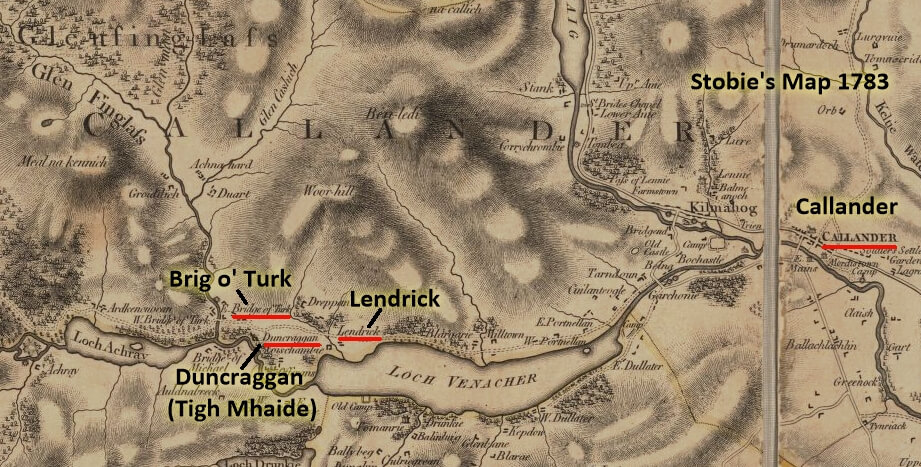
Below are four stories of Muckle Kate Ferguson (1798-1872), known as “the fattest woman in Britain.” She was proprietor of Ferguson’s Inn, known in the Gaelic as Tigh Mhaide, located at Brig o’ Turk at the foot of Glen Finglas in Callander parish in historic Perthshire, Scotland (present-day Stirling Council Area). Although her former inn is today a ruin, you can still stay at her refurbished house next-door which is a self-serve cottage available for rent.
Muckle Kate was a friend to local smugglers, a host to Queen Victoria, and beloved by local residents.
Muckle Kate was born Catherine Stewart in 1798 and is descended from the Stewarts in Lendrick, a cadet branch of the Stewarts of Annat, who are one of the principal families of the Stewarts of Balquhidder.
For more information on Muckle Kate’s ancestors, go here:
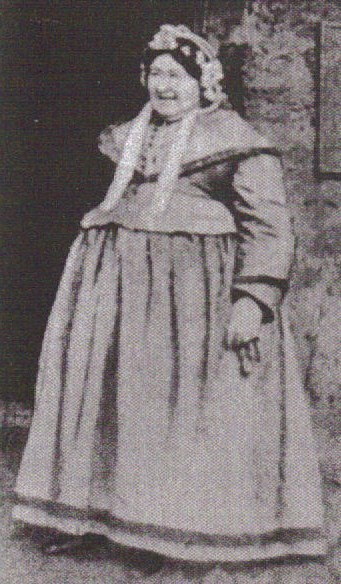
Muckle Kate Ferguson (nee Stewart), 1798-1872
“The Fattest Woman in Britain” meets Queen Victoria
by Archie McKerracher (excerpted from Perthshire in History and Legend by Archie McKerracher, (c) 1988 the Estate of Archie McKerracher, published by John Donald Publishers, Edinburgh, pp. 111-114.)
Muckle Kate Ferguson [was known as] the fattest woman in Britain. [Note: “Muckle” is Scots for “big”.] She was born Catherine Stewart at Landrick on Loch Venacher and grew up a slim, active girl. She married Donald Ferguson [sic, John Ferguson] and settled down as the hostess of a local hostelry politely called ‘Ferguson’s Inn’ at Brig o’ Turk. It was better known by its Gaelic name of Tigh Mhaide, “The House of Sticks”, perhaps from the custom of keeping a reckoning by making notches on a stick by those who could not write.
Kate Ferguson began to put on weight as she grew older and steadily increased in bulk until she weighed in at over 25 stone (350 pounds). Her broad beaming face and hearty good humour made her inn a popular one, both with the locals and the many tourists who came by coach to visit the Trossachs.
She entertained customers with lively conversation in a mixture of Gaelic and English, seated in a large chair in the small, smoke filled room where drinks were served. While the serving girls brought in the drams, Kate took the cash and dropped it into a large leather purse attached to her skirt which acted as her till. Sometimes a generous gentleman might pay her more than was due and so it came about that Kate got out of the habit of giving change at all. This eccentricity made her all the more renowned.
In 1869 Queen Victoria made a private visit to nearby Invertrossachs House. Although supposedly travelling informally, the Queen was accompanied by her daughters, the Princess Louise and Beatrice, Lady Churchill, and Colonel Ponsonby, and seventeen maids, footmen, cooks, coachmen, and the renowned John Brown, the Queen’s personal servant.
Queen Victoria had… learned of Muckle Kate Ferguson and decided the whole party should visit her. Kate had been given warning of the visit and was standing outside her inn dressed in her finery when the royal party arrived. She received the queen with Highland courtesy and native dignity, and the two enjoyed a friendly conversation.
Queen Victoria recorded the event in her diary: “We stopped at what is called ‘Ferguson’s Inn’, but is in fact the very poorest sort of Highland cottage. Here lives Mrs. Ferguson, an immensely fat woman, and a well known character, who is quite nice and well dressed, but will not leave the place where she has lived all her life selling whisky. She was brought out to see me, shaking hands with me and patting me. She walks with a crutch and had to sit down.”
The Queen presented Kate with two sovereigns which she kept to her dying day and bequeathed to her posterity. This incident made Kate famous throughout the land, and for years afterwards her portrait appeared in postcards in sop windows all over Britain.
Less well known is the unfortunate misunderstanding which occurred due to Gaelic speaking Kate’s difficulty with English. It appears the Queen’s party were greatly embarrassed when Kate offered them tea and “a gill a-piece”. All of them refused the apparent offer of the demon drink and departed quickly, leaving poor Kate wondering what she had done to offend. All she had offered them was a “jeely piece” or jam sandwich!
Muckle Kate Ferguson died in 1872 and her body was carried in a specially built coffin drawn by a team of horses. Hundreds followed her funeral procession to St. Kessog’s kirkyard at Callander. Kate’s old inn of Tigh Mhaide at Brig o’ Turk has fallen into ruin but the old house beside it built for her retirement still stands and has been converted into a private house of the same name. the front window still bears the marks where it was widened to allow Kate’s coffin to pass through, it being too large to leave by the door.
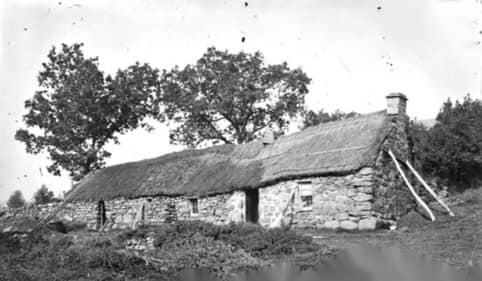
Tigh Mhaide – Ferguson’s Inn, Brig o’ Turk – The home of Muckle Kate
Muckle Kate of Brig o’ Turk, 1870
by Sue Mackay, Callander Heritage Society
Catherine Ferguson, more widely celebrated as “Big Kate”, or “Muckle Kate” the popular landlady of the Inn at the Brig o’ Turk, known to past generations as Tigh Mhaide.
In her youth, Katie Stewart was an active girl, lithe and slim, with her own share of good looks and a winsome manner. She was born at Lendrick, near the western end of Loch Vennacher, and, to the Gaelic-speaking population, she was known to the end of her days as “Ceat Larick.”
While still a young woman, she was married to Donald Ferguson and settled down in life as the hostess of Tigh Mhaide. After some time Mrs. Ferguson began to put on flesh, and when she approached middle life her physical proportions had increased to an amazing extent. The process of slimming was unknown in those remote days and if Mrs. Ferguson put into operation such native remedies as she knew, they were of no avail, and indeed seemed to have the opposite effect. For she steadily increased in bulk until, at the top of her form, she is said to have turned the scale at something over twenty-four stones of weight (336 lbs). No person of such enormous proportions had ever been seen in the neighbourhood before outside a travelling variety show. Even some of the professional giantesses seemed but pale and anemic shadows beside the lusty hostess of Brig o’ Turk.
Mrs Ferguson was a living exemplification of the adage “laugh and grow fat.” Her broad beaming face and her hearty good humour radiated cheerful kindness and attracted customers. The extraordinary proportions of her physique brought the curious from far and near and no tourist or visitor passed her door.
With all her good nature, Kate was an astute business woman. Usually she sat at the receipt of custom, in a capacious chair in the room where the drinks were served. She entertained her customers with lively conversation in the Gaelic or in English or in both. While her serving lasses brought in the drams Kate herself invariably took the cash, and the till was the ample leather-pouch fastened at her skirt.
Gentlemen patrons generally passed her a coin or a sum much in excess of the price of their refreshment. Mrs Ferguson would smile and bow her thanks profusely, and hint that their kindness was too much. So in time it came about that except to local customers Kate got out of the habit of giving change at all.
The great event of Mrs Ferguson’s life was the visit paid to her by Queen Victoria. Her Majesty, with her suite, was in residence at Drunky House for some days in the autumn of 1868. Hearing much of the notable landlady al the Inn at Brig o’ Turk, the Queen very graciously called at Tigh Mhaide on one memorable afternoon. Kate had got a hint of the proposal and was dressed in her best. She received Her Majesty with Highland courtesy and native dignity, so far as circumstances would permit. The Queen was very interested and most kind. She conversed with her humble but weighty subject in the most natural and friendly manner and, before leaving, presented her with a gift of two sovereigns. Kate prized the golden coins beyond all her earthly possessions during her life, and at her death bequeathed them to her posterity as a sacred inheritance.
The incident of course made Kate more famous than ever. Paragraphs, describing her personality in vivid detail, appeared in every newspaper in the land, and, for years afterwards, the photograph of “Big Kate” appeared in the shop windows all over the country, along with those of the leading celebrities of the period.

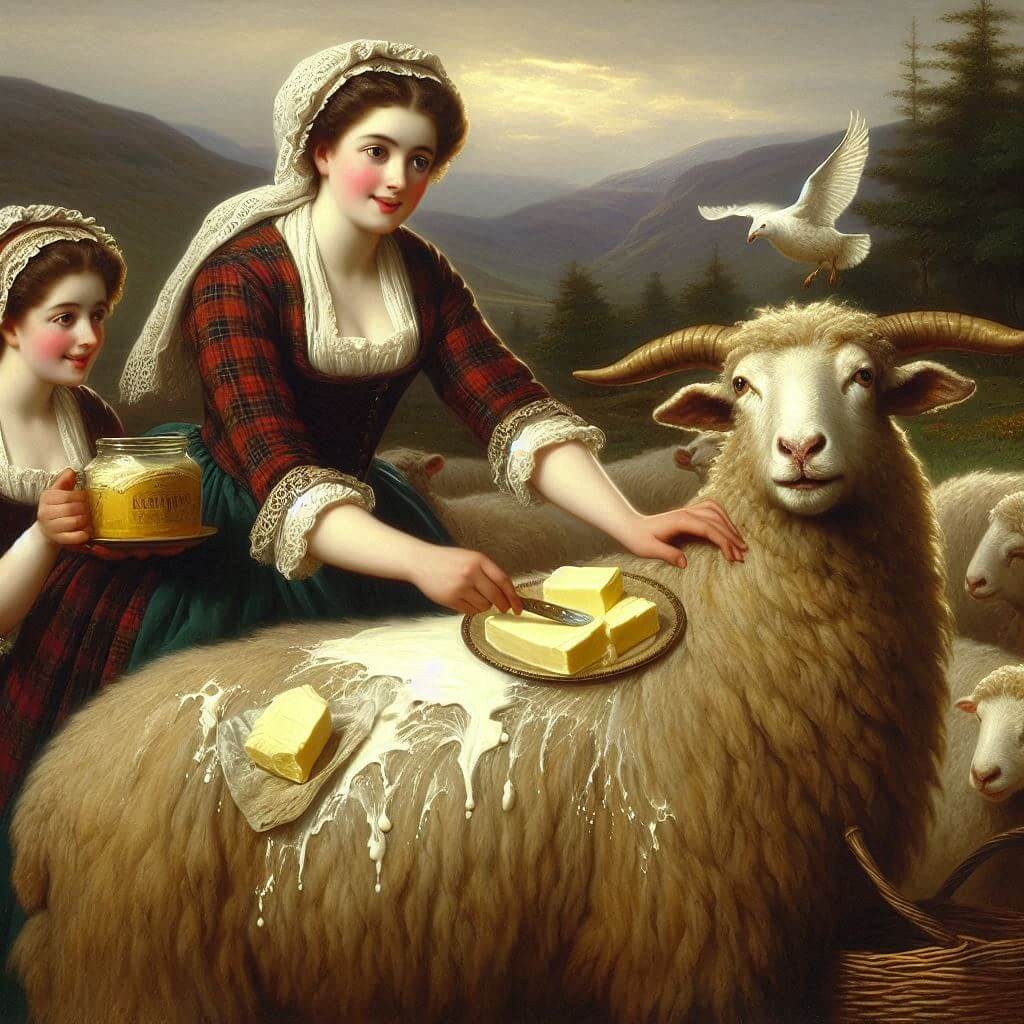
Muckle Kate Greets Queen Victoria
AI-generated image using Bing Image Creator.
(Kate is not shown here in her proper ampleness because Bing rejected the word “large” in the image prompt as violating community standards. After trying a few synonyms, Bing threatened to ban my account, so I gave up.)
Muckle Kate and the Smugglers
by Sue Mackay, Callander Heritage Society
The districts of Brig o’Turk and Loch Katrineside retained considerable notoriety as centres of smuggling in the 1800s. It may be remarkable, but it is true, that the smugglers had the sympathy and often the active assistance of most of their neighbours in harbouring illicit material. The old people in the Brig o’ Turk used to recount with pride stories of the resource of the local smugglers in evading the attentions of “the Gaugers.”
The smugglers had no more loyal friend than “Big Kate.” She was a licence-holder, and, so far, in the confidence of the Officers of Excise riding from Stirling or Callander they usually dismounted at her Inn, often in the dark of a winter morning and rested their horses while refreshments were served. Kate a gratuitous host kept the Officers entertained while word of the Officers present filter through the Glen, never did the Officers discover an illicit still, and never once was a smuggler caught in the district of Brig o’ Turk.
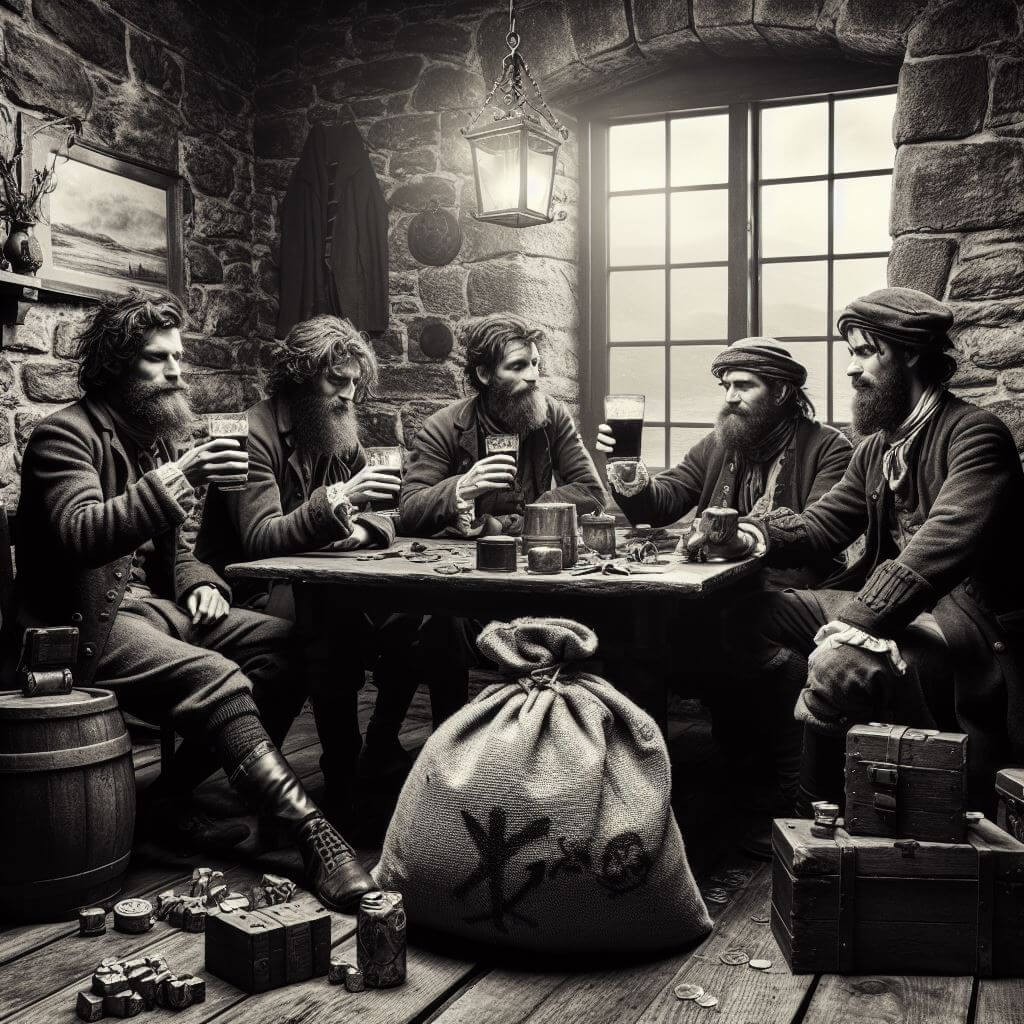
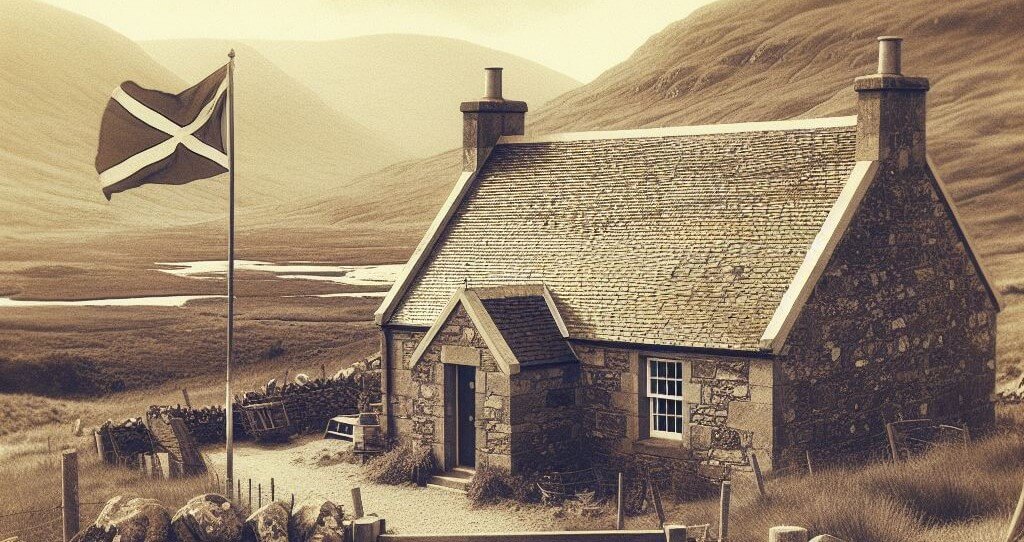
Smugglers and Their Loot at Tigh Mhaide
(AI-generated image using Bing Image Creator)
The Funeral of Muckle Kate
by Sue MacKay, Callander Heritage Society
On a March afternoon in 1872 a group of small boys from Bridgend were returning to school after dinner. From the top of the bridge, they saw a long, straggling [funeral] procession coming round the bend on the Trossachs road at the “shouther of Bochastle.” There was a coach drawn by two horses leading, followed by groups of men on foot, men on horseback and in gigs and in other carriages of various descriptions. It was a long procession, for as the boys looked the leading coach had reached the approach to Kilmahog Bridge, while its followers were still trickling round the bend above Bochastle. It turned out to be a funeral party from Brig o’ Turk taking to the old Churchyard of Callander for burial, the body of a very notable lady Mrs. Catherine Ferguson, more widely celebrated as “Big Kate”, the popular landlady of the Inn at the Brig o’ Turk, known to past generations as the Tigh Mhaide. Catherine Ferguson died on the 16th March, 1872, at the age of 74, and was buried in Callander Old Kirk yard of St Kessogs.
Kate Ferguson had been ailing for some years, and had been attended by Dr M’Nab, of Callander, for several weeks past on account of an increase of unfavourable symptoms. She passed away on Saturday afternoon at one o’clock. It was quite unexpected.
Mrs. Ferguson was a well-known public character. For thirty-five years, she was the lease-holder of the Duncraggan or ” Brig o’ Turk ” Inn, and by her long residence, her stout, professional appearance, and, most of all, by her remarkable force of character, her fame was spread far and wide. Catherine’s maiden name was Stewart her father, Mr. Daniel Stewart (sic – parish marriage records show his name as John Ferguson), was a respectable farmer in Lendrick. She was born in 1798 at Lendrick farm, during her long and active life, she was hardly ever a couple of miles distant from the place of her birth.
Kate’s Inn was a favourite resort of anglers, drovers, pedestrians, tourists and other habitués of the romantic region of the Trossachs; her frank, kindly disposition, and her attention to the comforts of her guests, gave to her Inn very much the character of a home.
Kate was married somewhat late in life, she was never blessed with children, and had been for a long time a widow. Muckle Kate Ferguson died in 1872 and her body was carried in a specially built coffin drawn by a team of horses. Hundreds followed her funeral procession to St. Kessog’s Kirk yard at Callander.
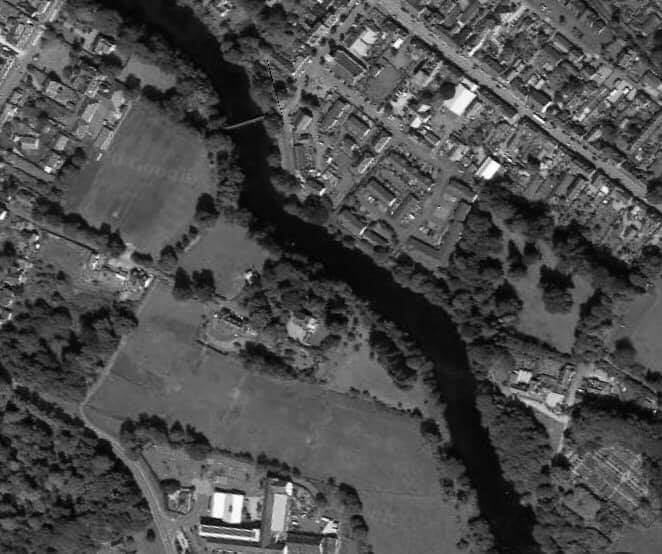
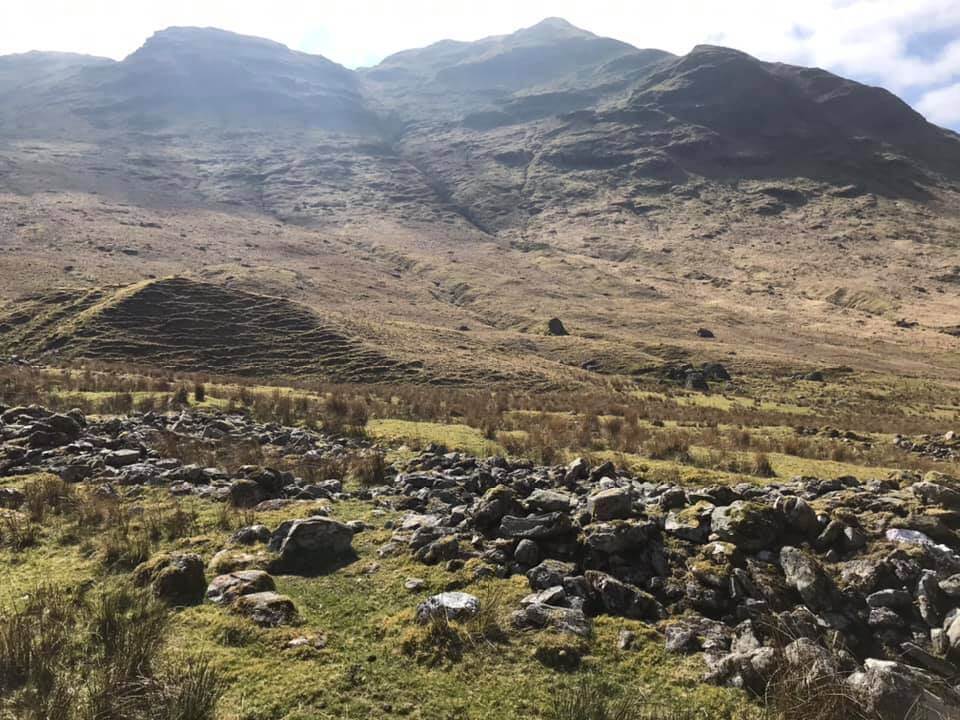
Kate’s old inn of Tigh Mhaide at Brig o’ Turk has fallen into ruin, but the old house beside it built for her retirement still stands and has been converted into a private house of the same name. The front window still bears the marks where it was widened to allow Kate’s coffin to pass through, it being too large to leave by the door.
Today, there is no gravestone which marks Catherine Ferguson’s grave in the burial ground of St Kessog’s. Kate clearly had enough money to afford a headstone and yet there is no headstone recorded or found within the old Burial ground. Her father Daniel Stewart is buried there and there are many Ferguson’s buried within the old walls, one of whom will be her husband and yet there is no mention of Kate.
Does her grave lie flat buried beneath the grass?
The restoration of St Kessog’s old burial ground would be a worthwhile project, to recover lost graves and restore the burial ground so it may be accessed and open to the public again.
Now it begs the question: what does the public think about the restoration of the ancient burial grounds?



I am descended from Kate’s next younger sister. From my research Kate was one of eleven children and outlived all her siblings. I understand that she was buried in Kilmahog burial ground. Her estate was managed by the husband of one of her nieces who did not live locally. I don’t know what happened to her property. Two of her sisters are also buried here, none seem to have marked graves, it would be nice to know if there are any church records of burials there. Her brother Archibald is also buried there. He was unmarried and the last male of that line of Stewarts of Annat. The name Archibald Stewart has been carried on by some of their sisters, to my generation in my line.
Kate’s husband John Ferguson may have been a first cousin through their mothers.
I have visited the burial ground a coulpe of time and the grave stones are deteriorating rapidly. The last visit, I was sad to see that there was no mention of Kate at Brig OTurk, there used to be a sign. I am proud of mher and she should be celebrated not mocked. I suppose it is not PC these days.
Thank you for your comments, Brigid. I presume that you are descended from Margaret Stewart and James Dewar. I believe it was Kate’s nephew-in-law, William McGregor in Edinburgh, who dealt with her estate after her death. Yes, she and her husband were first-cousins on the McKinlay side. And, yes, they are buried at the old St. Kessog’s cemetery in Callander. My colleague, Sue Mackay, from the Callander Heritage Society, advises me that Muckle Kate’s burial is recorded in St. Kessog’s along with her entire family, however the stone has likely fallen down and become buried beneath the turf and would require excavation — though records confirm that she is indeed buried there. She is a worthy ancestor to be proud of and nobody is mocking her. “Muckle Kate” is how she was known in the community during her lifetime; it is not an insult.